Cane: An Encore

If you’ve seen me in person, you have seen me with my cane. I wrote about it last year for Next Avenue, a PBS-affiliated digital magazine. The article (and me by extension) has become a casualty of the current administration and its massive cuts to the Corporation for Public Broadcasting. Next Avenue, which was an important publication for older writers and readers, remains, albeit in a much shrunken form. Many articles from its archives are no longer available on its new website. I am saddened. So was another cane user who searched for the article recently and came up with nothing.
If you didn’t catch it the first time, or want an encore reading, here is my original, slightly altered, version.
Cane
By Susan B. Apel
I used to stride purposefully, long, strong steps through a supermarket aisle or on the impossibly skinny sidewalks of Paris’s Left Bank. Up and down the stairs of the metro without a thought. Now I am, in the words of my neurologist, “a little gimpy.” I wait for the bus and am grateful for the ones that arrive with the lowering stairs. Now I take taxis (reluctantly) and warn the driver when I am getting out that I require more than a minute to emerge from the cramped back seat, unfolding stiff legs and ordering them into weight-bearing mode. Invariably, the drivers are patient. For me, though, none of these changes are welcome.
I now carry a cane, and while I don’t feel exactly self-conscious, I do recognize that it projects a whiff of vulnerability that feels new. After traveling in Europe for 30 years without incident, I was pickpocketed for the first time while crammed into the aisle of a crowded train in Nice last year. Maybe the cane, and my consequent struggle for balance in the swaying sea of travelers, made me a target. I can’t prove it, hate thinking it, but suspect it is true. The obvious vulnerability, along with the fact that I am perpetually one-handed and therefore battling to hang onto my luggage while grabbing an escalator handrail, or even just a supermarket grocery cart, are the downsides of having a cane.
But upsides have been sneaking in. While traveling, in a single afternoon I was motioned past crowds of hundreds at passport control and again at a long taxi queue and given a first place in line. Not too shabby. I get to board airplanes first.
One of my canes is purple. People like the color and sometimes smile and comment. The somber black one gets less attention. I swear a man once tried to pick me up as I passed him on my hometown sidewalk by chatting and comparing my cane to his own. Another man, on a snowy afternoon, showed me how he had attached an ice grip to the bottom of his own cane and told me where to get them (on Amazon.)
The everyday kindnesses are abundant. People—even, or maybe especially, the young ones—get up to offer me seats on buses and the never-frequent-enough benches. So far, not a single driver has gunned an engine at a crosswalk when I am making my way to the other side of the street. Recently I sat next to two gentlemen in a Paris restaurant and shared nary a word. Until my cane fell and hit the floor with a loud thwack, inches from one of their feet. He picked it up, and thus began our animated exchange about American universities and the price of Left Bank hotel rooms and his firm but uninformed opinion that I should forsake my boutique hotel of some thirty years for the historic but impossibly pricey Lutetia.
That I have enjoyed these brief interchanges stands in contrast to the experiences of many same-aged friends. From time to time, they report, similar gestures are made by people who try to assist them: someone holds the door, or says “after you” in the Starbucks line. The friends aren’t happy; some tell their stories with indignation and anger and proclamations of not needing help. One friend who had been offered a hand in rising from a church pew insisted on demonstrating to our coterie that he could get up from a seated position easily without help, and for emphasis, commandeered a nearby chair and proceeded to sit and rise three or four times. It led me to question older friends about this. Many if not most said they didn’t need assistance, if offered help they refused, and most of all, resented what they saw as ageism: an assumption by others that they were not self-sufficient.
I am not burdened with that problem. My cane telegraphs that sometimes, often even, I am not so self-sufficient. It frees me from wondering if people are stepping in laden with assumptions because my hair is gray and I am far from youthful, a decade or more on the other side of middle age. Clearly they are responding to the cane, which causes my own response to be gratitude instead of indignation. Recently in a doctor’s office waiting room, I had sat for too long and when my name was called, I reached for my cane and struggled to stand up. A young teenaged boy looked up from his phone to inquire “Can I help you?, beginning to rise to his feet. This time I managed on my own, but pondered for the remainder of the day how sweet was that encounter.
Such acts of kindness are invaluable, and not just for practical reasons. This has become the era of meanness, or so it seems. When millions turn a blind eye to hate, when immigrants are dehumanized, when comments on social media are like razors, it is easy to assume that the kind people have ceased to exist. But that isn’t true. It is just that their kindness is dormant, invisible, awaiting an opportunity to show itself. I may now be striding less purposefully, more slowly, and surely hesitatingly on stairs. But my gimpiness, my cane, have become vehicles for eliciting, or maybe just revealing, people’s better sides. This series of connections is a small but significant pleasure, all the sweeter for it having been so unexpected, and so very human.
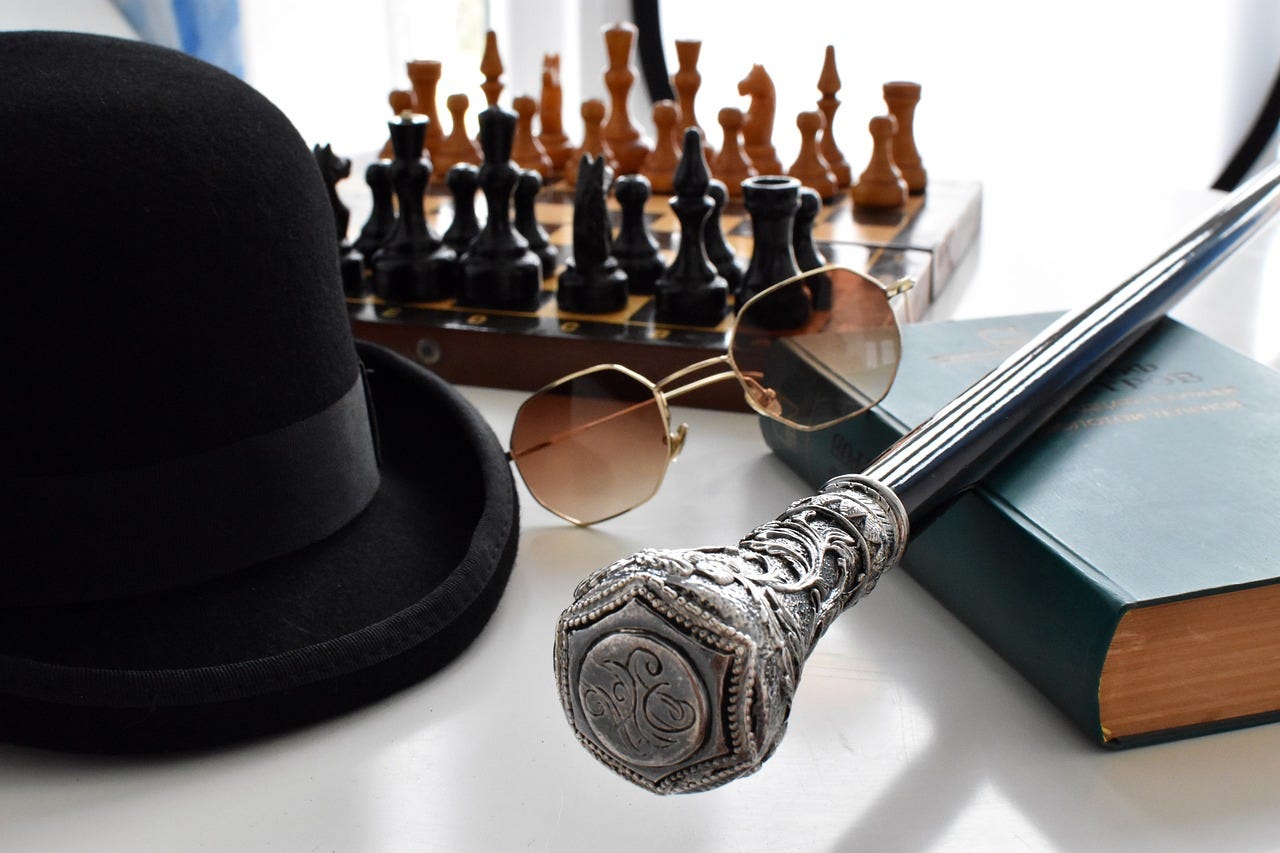
(Photo image, top, from Pixabay. I have, but do not currently play chess. I do have a hat that resembles the one in the picture, though.)
—-———————————————
Thank you! You’re reading Artful, a blog about arts and culture in the Upper Valley, and I hope you’ll subscribe (still free) and then share this post with your friends and on your social media. We now have over 3250 subscribers.
And in case you are wondering . . . Susan B. Apel shuttered a lifelong career as a law professor to continue an interest (since kindergarten) in writing. Her freelance business, The Next Word, includes literary and feature writing; her work has appeared in a variety of lit mags and other publications including Art New England, The Woven Tale Press, The Arts Fuse, Next Avenue, Image Magazine, and Persimmon Tree. She connects with her neighbors through Artful, her blog about arts and culture in the Upper Valley. She’s in love with the written word.